The Telegraph / Editorial platforms
Building the platform behind richer digital journalism.
A connected editorial platform spanning collaborative authoring, reusable content formats, media workflows and published experiences.
- My role
- Platform architecture, hands-on engineering and technical leadership
- Period
- Part of my Telegraph work, 2017–present
- Delivery
- Established platform · ongoing development
01 / The business problem
The work behind the brief.
A newsroom needs more than a place to write text. Editors need to build rich digital experiences, work together, handle media, preview the result and publish it reliably. Every new format adds another set of decisions about content, permissions, rendering and delivery.
My work has been to turn those connected needs into reusable platform capabilities. Arthur is the editorial interface within a wider system of collaboration services, APIs, templates and public embeds. The scope crosses the tools journalists use and the experiences readers ultimately see.
02 / What I built
From the interface to the underlying system.
An editor that adapts to the content
Configuration-driven authoring lets different content formats define their own fields and behaviour within a shared editing system. The platform includes permissions, previews and media workflows, alongside native Atoms authoring capabilities.
A library of reusable editorial formats
Video, podcasts, quizzes, votes, timelines, tables, image comparisons and data visualisations share the same platform. Editors can find existing content, see publication status and template versions, and reuse a format without commissioning a separate tool for every story.
Audio and video as editorial products
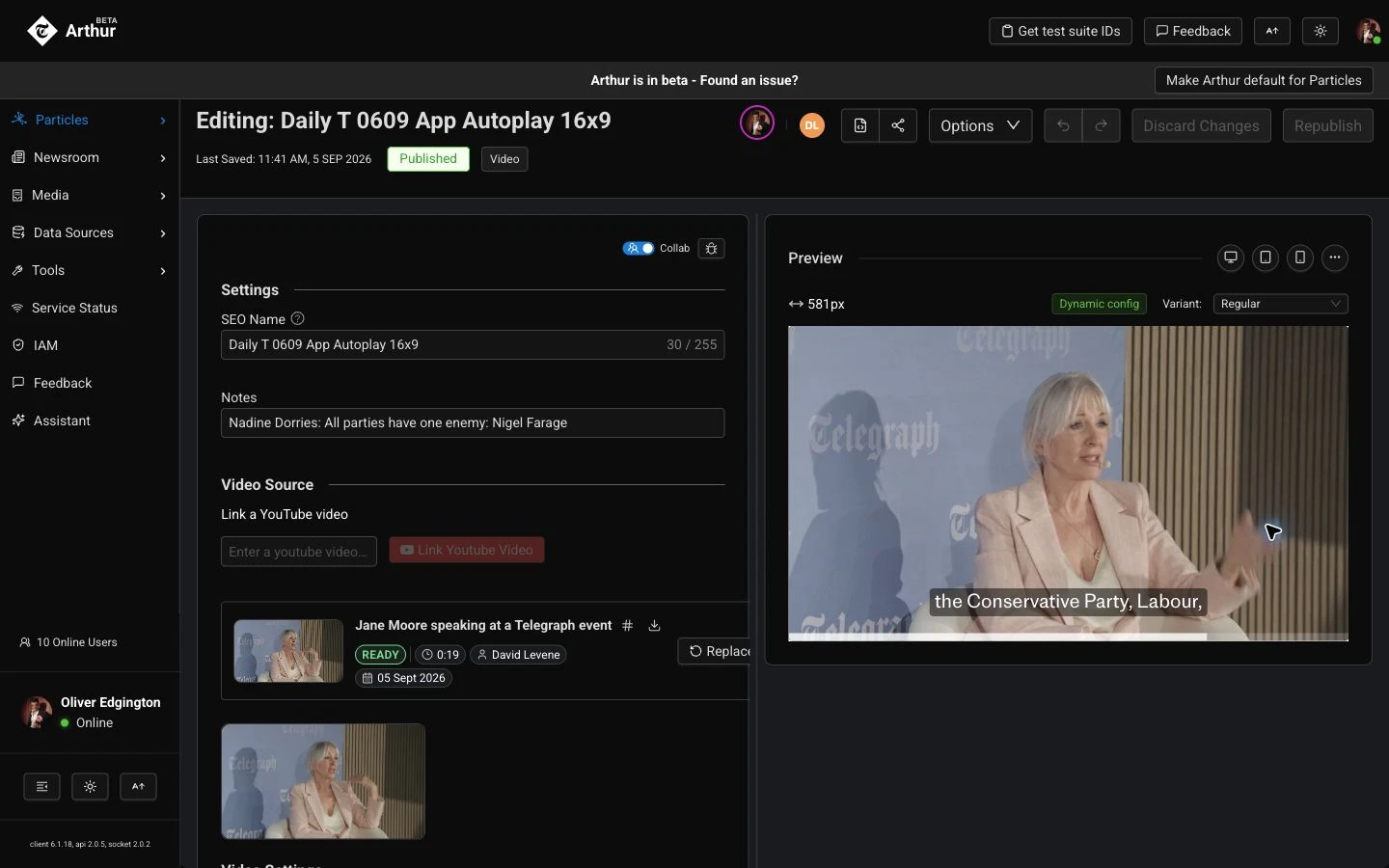
Video authoring brings together source media, orientation, playback, advertising settings and captions. Podcast authoring supports individual players, episode lists, carousels and app podcards. Those format-specific controls sit beside a live preview so editors can judge the reader experience as they work.
Practical AI in the media workflow
Smart Search accepts article context or search prompts to help editors find suitable imagery. Upload workflows support AI-assisted title generation, while existing image reuse and cropping preserve the asset’s metadata and identity.
Collaboration with clear ownership
The CMS and socket service support shared editing and presence. I worked across the client, collaboration service and persistence APIs to establish which system owns the document, its validation and its saved state.
Preview in the context readers will see
The publishing workflow includes desktop, tablet and phone previews, with web-article and Telegraph-app layouts. Editors can inspect an embed in its host-page context and select layout variants before copying the integration code. The preview shell uses clearly labelled placeholder article content.
A path all the way to publication
The API stores content and coordinates generation. Versioned templates turn that content into reusable experiences, while the embed runtime connects them to host pages and captures interaction signals.
A closer look
Inside Arthur: from discovery to delivery.
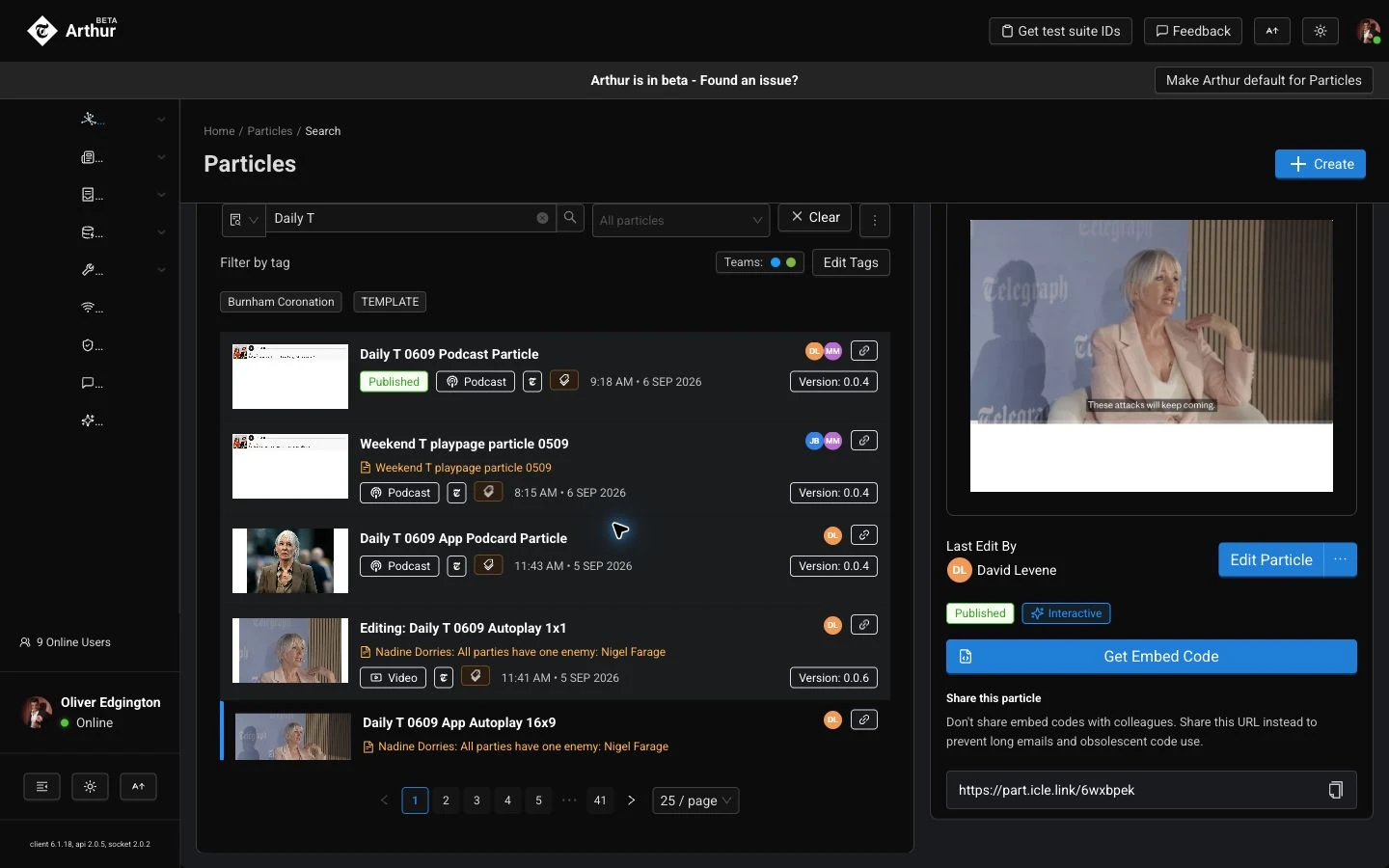
Find, reuse and manage published content
Production: a Daily T search brings together existing video and podcast content, publication status, template versions and a preview. Editors can return to the work and obtain its embed from the same place.
View full size ↗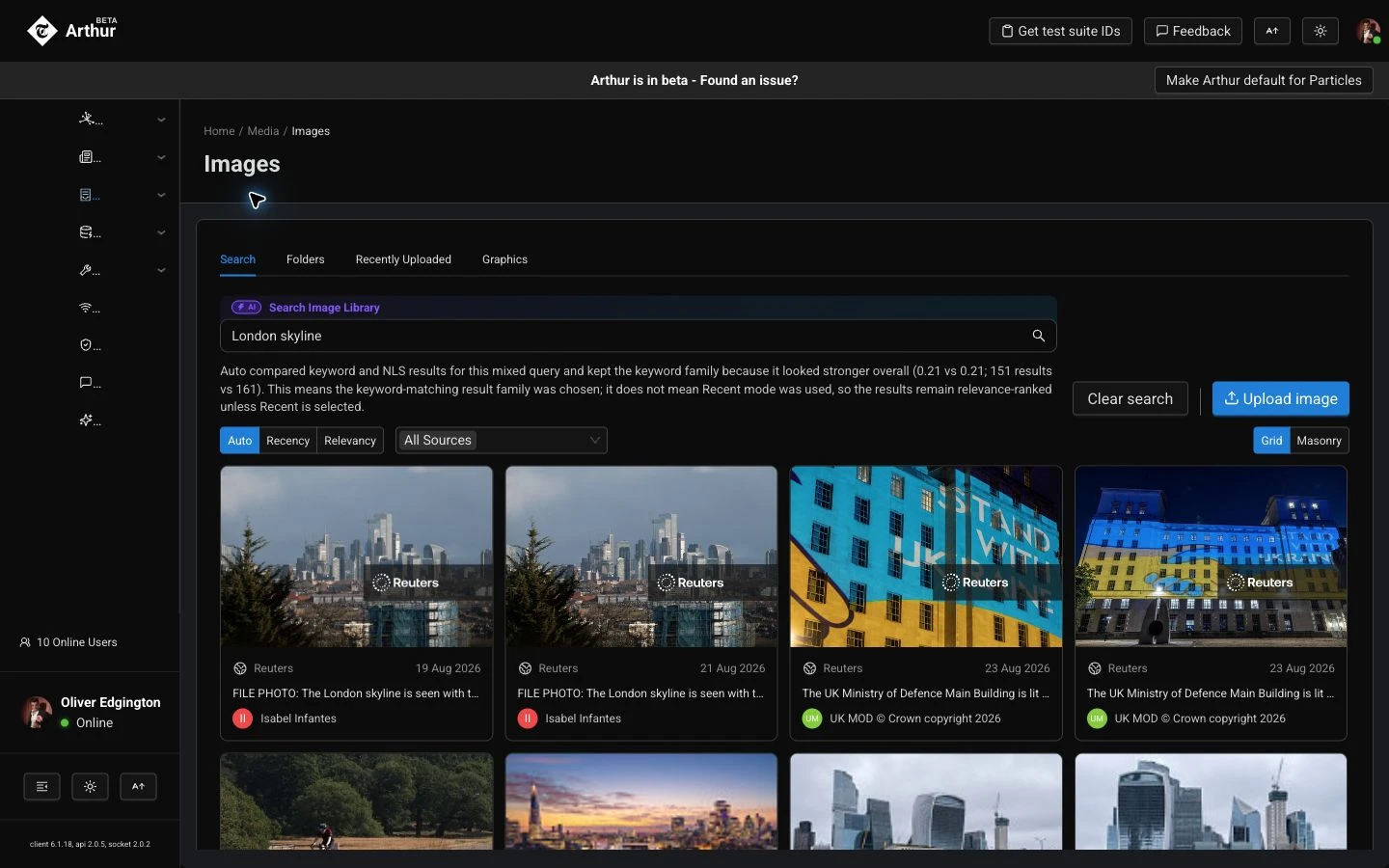
Discover imagery without leaving the workflow
Production: image search brings connected photography sources into the CMS, with relevance and recency controls, source filtering and visible credits. Agency watermarks and attribution remain intact.
View full size ↗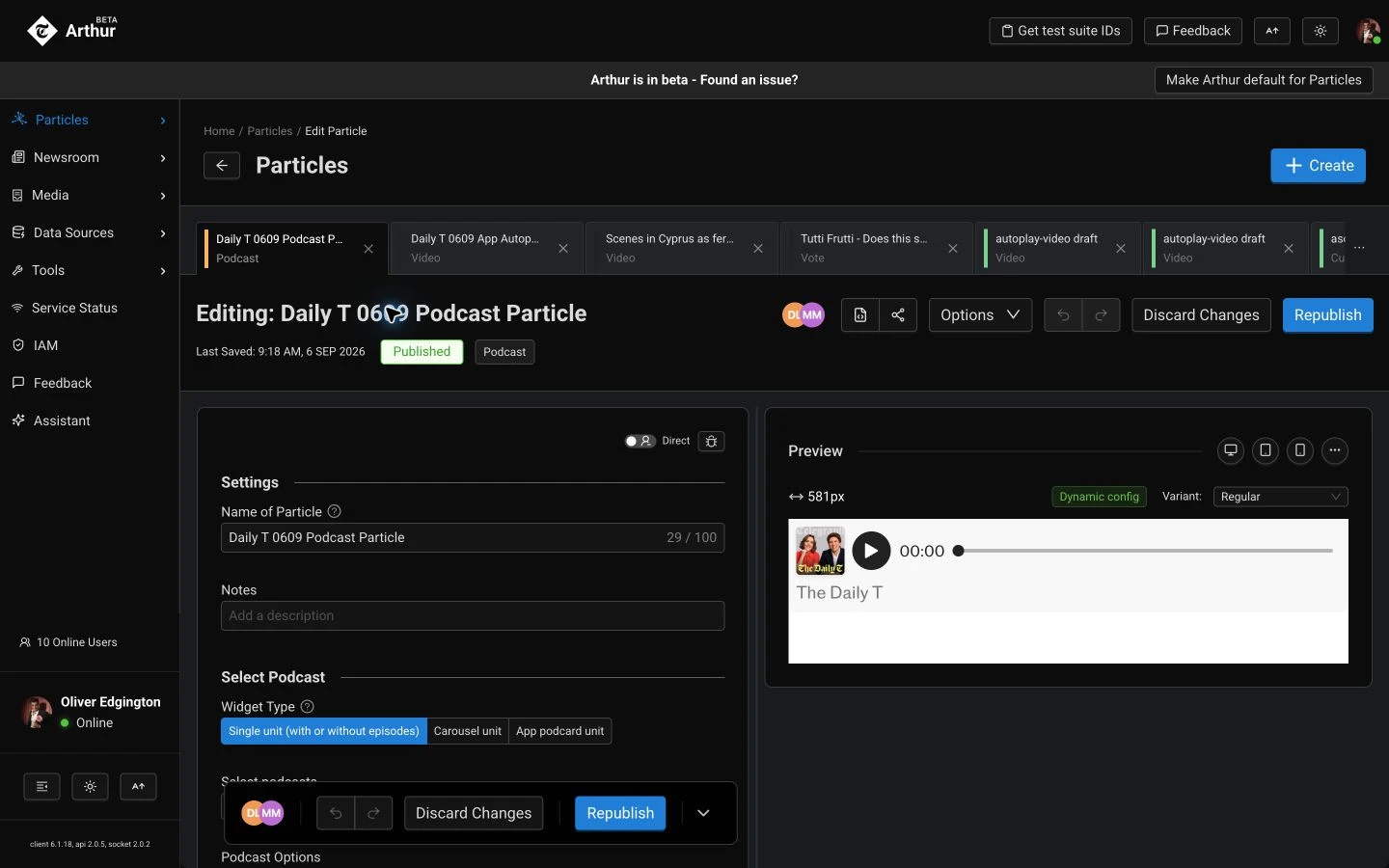
A dedicated workflow for audio
Production: the Daily T podcast editor combines podcast and episode selection with player, carousel and app-podcard options. The reader-facing player is previewed alongside the authoring controls.
View full size ↗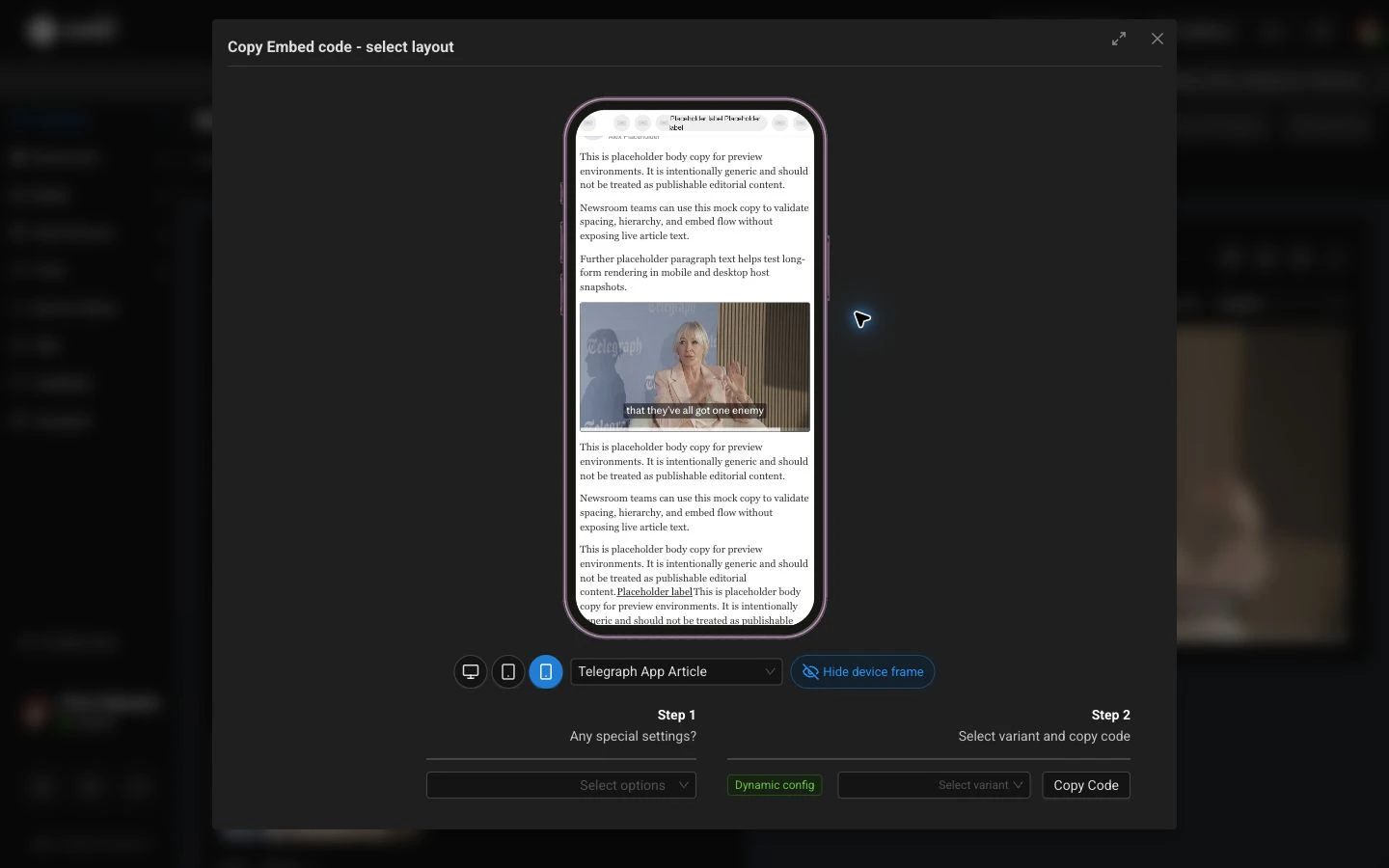
Check the experience in its destination
Production: the embed workflow previews a published video inside a phone-sized Telegraph app article. The surrounding article is an explicitly labelled placeholder preview, with desktop and tablet options available too.
View full size ↗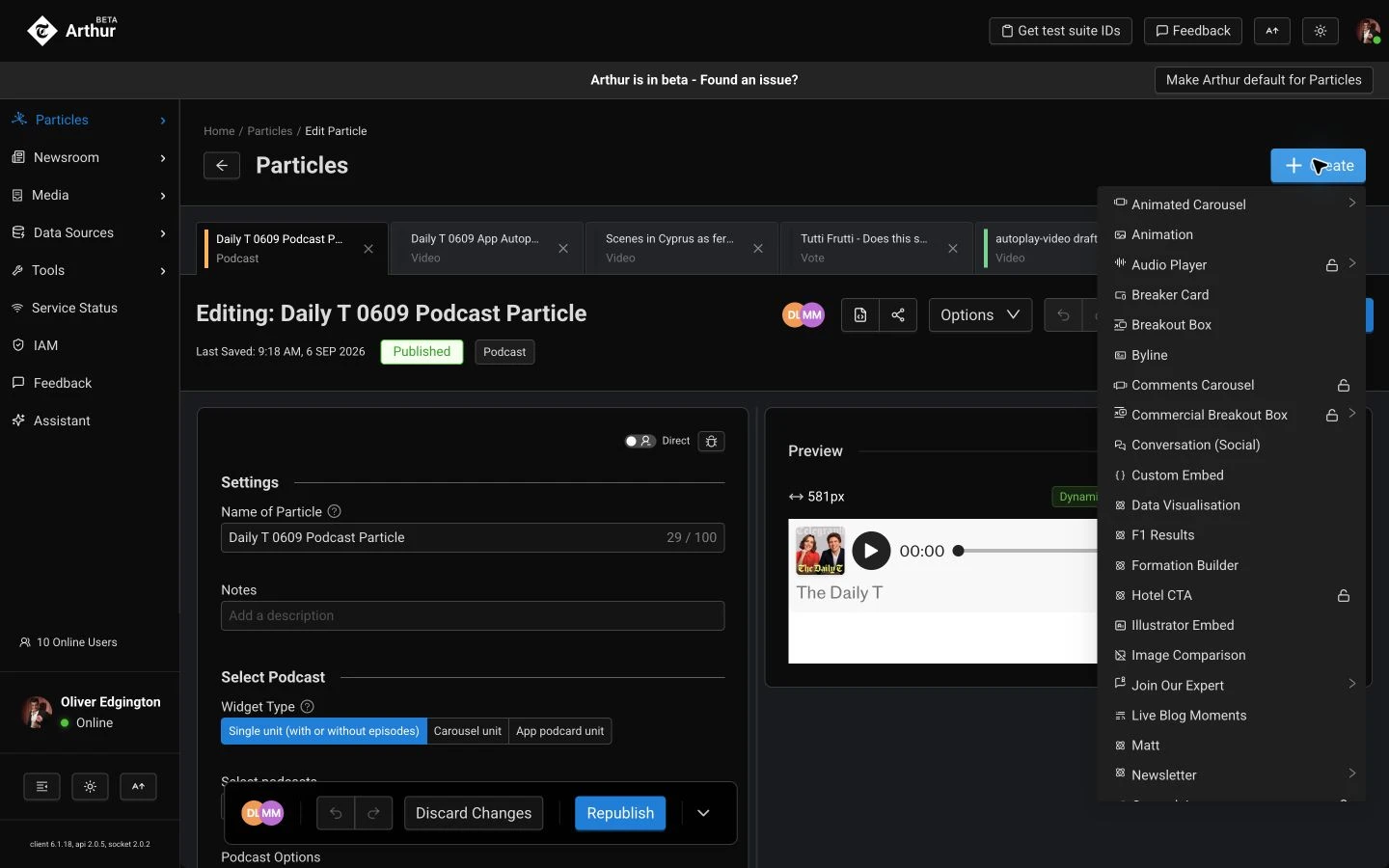
Many editorial products, one authoring platform
Production: part of the format catalogue, spanning animation, audio, commercial components, data visualisation, sports, image comparisons and newsletters. Version choices and permission indicators sit within the shared creation workflow.
View full size ↗How the pieces fit
- 01
Create together
Editorial UI, permissions and shared state
- 02
Prepare & publish
Persistence, compilation and reusable templates
- 03
Reach readers
Embeds, host-page integration and engagement signals
03 / Decisions that mattered
The judgement behind the build.
Make formats configurable
A platform becomes expensive if each new format needs its own bespoke editor. Shared authoring machinery with format-specific configuration gives teams room to expand while keeping the underlying behaviour consistent.
Give shared state one authority
When several people edit together, conflicting client and server interpretations of “saved” become a product problem. Server-owned canonical state and modified status make the editing contract explicit and easier to investigate.
Treat publishing as a complete workflow
A correct editor is only one part of delivery. Preview behaviour, template versions, media readiness and the host-page embed all need to agree. I work across those boundaries so local changes remain compatible with published experiences.
04 / What this enabled
Concrete capabilities. Useful foundations.
- A reusable authoring and publishing system for multiple editorial formats.
- A shared collaboration model with explicit responsibility for document state and saving.
- Connected preview, generation and public delivery paths, with runtime analytics for published experiences.
Arthur is part of an established publishing estate, with ongoing development across authoring, collaboration and delivery.
05 / Technical detail
For the closer look.
The architecture spans the Arthur CMS, socket service, Particles API, template pipeline and embed runtime. Configuration controls authoring behaviour; the collaboration service owns canonical shared state. Versioned assets and an iframe-to-host messaging bridge connect the publishing pipeline to the public page. Trace-led debugging helps follow a change across these services.
- React
- Node.js
- Yjs / WebSockets
- APIs
- MySQL
- Redis
- AWS
- Handlebars
A similar challenge?
Let’s talk about your business.
If your teams depend on a complex internal tool, I can help turn fragmented workflows into a platform that is easier to use, extend and operate. This is the kind of work where product understanding and engineering ownership need to stay close together.