KISSD / Connected hardware & cloud
Building the operating platform for a connected business.
From customer touchscreens and fleet servicing to advertising, commercial agreements and revenue sharing. One connected platform across the physical product and the people running the business.
- My role
- Technical architecture, machine software and cloud platform engineering
- Period
- 2026
- Delivery
- Active development · cloud staging and machine tooling
01 / The business problem
The work behind the brief.
A hydration station is a physical product with a software business around it. The customer interaction, payment flow, dispensing hardware, advertising screen and maintenance process all have to fit together. As the estate grows, operators also need a coherent view of the machines and the organisations using them.
I built across the machine and cloud layers: local controller software and customer interfaces, plus KISSD Connect for central operations. The central engineering constraint is simple: a machine must remain safe and usable even when its cloud connection is unavailable.
02 / What I built
From the interface to the underlying system.
Software at the machine
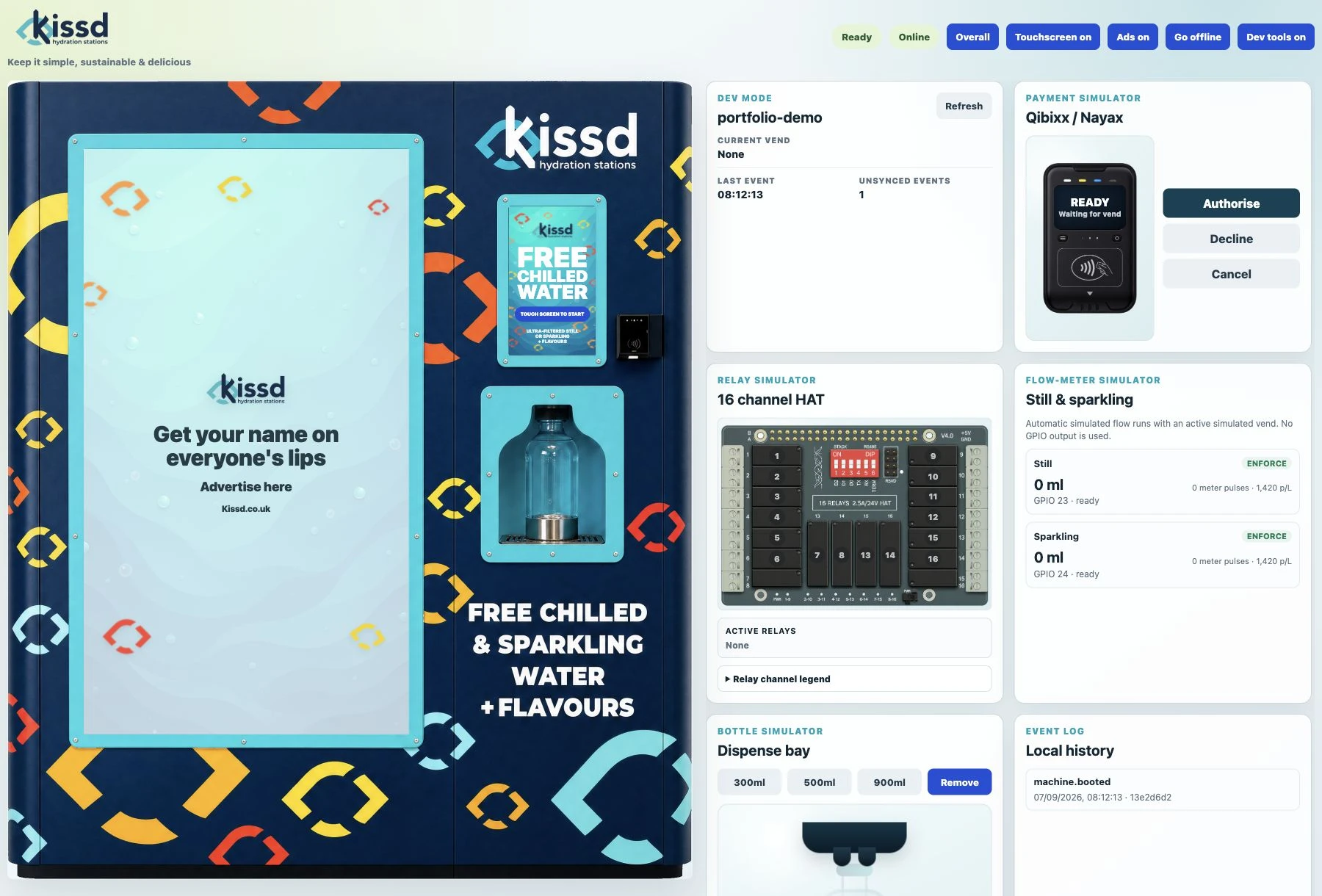
The controller coordinates customer interaction, dispensing states, maintenance and persistent event history. Separate display surfaces serve the customer touchscreen and advertising player. Payment and relay simulators allow those behaviours to be exercised during development.
A shared operating platform
Connect brings together estate management, products, servicing, content and advertising. Organisations, people, roles and estate scope determine which information and actions each operator can access.
Fleet operations and service ownership
Operators organise locations and machine groups, inspect synchronised state and turn a machine signal into an assigned service incident. Acknowledgement, ownership and resolution notes create an operational history. Closing a ticket does not erase a fault that the machine is still reporting: the service workflow and physical state remain distinct.
Products, pricing and availability
A central product catalogue supplies defaults, while machine-specific offers control what customers can buy. Operators publish customer labels, prices and availability to an explicit selection of machines. Commissioned flavour and relay assignments stay behind a separate boundary, so a commercial change cannot casually become a hardware change.
An advertising business inside the platform
Advertising spans creative uploads, review, campaign authoring, approval, targeting and activation. A creative asset being approved does not automatically make a campaign live. Activation checks the schedule and target estate before publishing machine manifests; synchronisation also reconciles campaign expiry and changes to group membership. Cached playback and proof-of-play evidence connect central planning to the actual display.
Commercial agreements and revenue sharing
Commercial terms have versions and effective dates. Activating an agreement creates the time-bound capabilities it grants, rather than leaving access as an unrelated switch. Revenue-share statements reconcile unique settled vends against their requested amounts and applicable agreement, retaining machine-level lines, rates and rounded GBP totals. Issued statements remain immutable, giving commercial conversations a stable record.
Different organisations, one controlled workspace
KISSD staff and client operators have different responsibilities. Organisation membership, role, machine scope and active entitlements combine to determine what someone can see and change. The workspace brings relevant actions and signals together, with search filtered to the user’s access. Account security, session controls and organisation sign-in configuration are part of the product, rather than an afterthought.
Delivery and testing beyond the first machine
Software releases and machine synchronisation provide a managed path for changes beyond the first device. The Digital Fleet Lab exercises repeatable scenarios, simulated estates and event histories. Replay and causal inspection help trace how a machine action becomes a cloud event and an operational view. Simulation is explicitly distinguished from physical-machine reporting, making it useful for engineering without presenting test activity as live business performance.
A closer look
One platform. The breadth of a business.
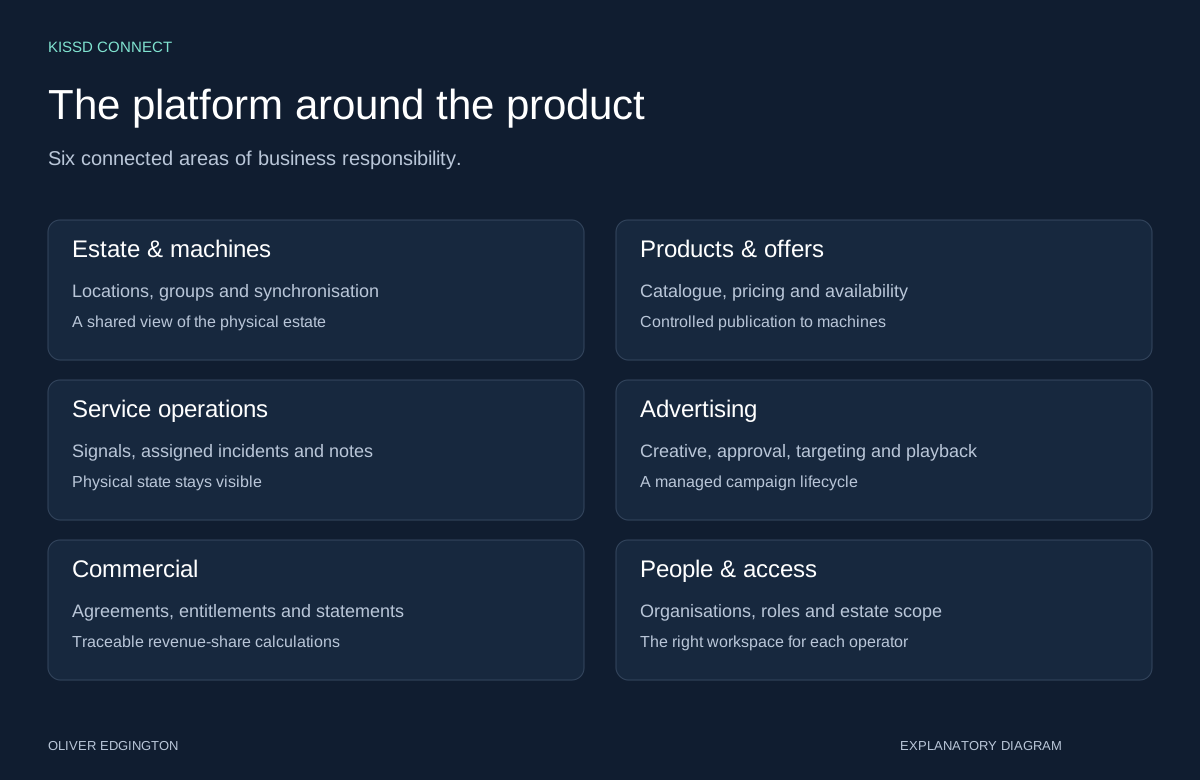
The breadth of Connect
Explanatory capability map: six business areas connected by shared machine data, organisation access and controlled workflows.
View full size ↗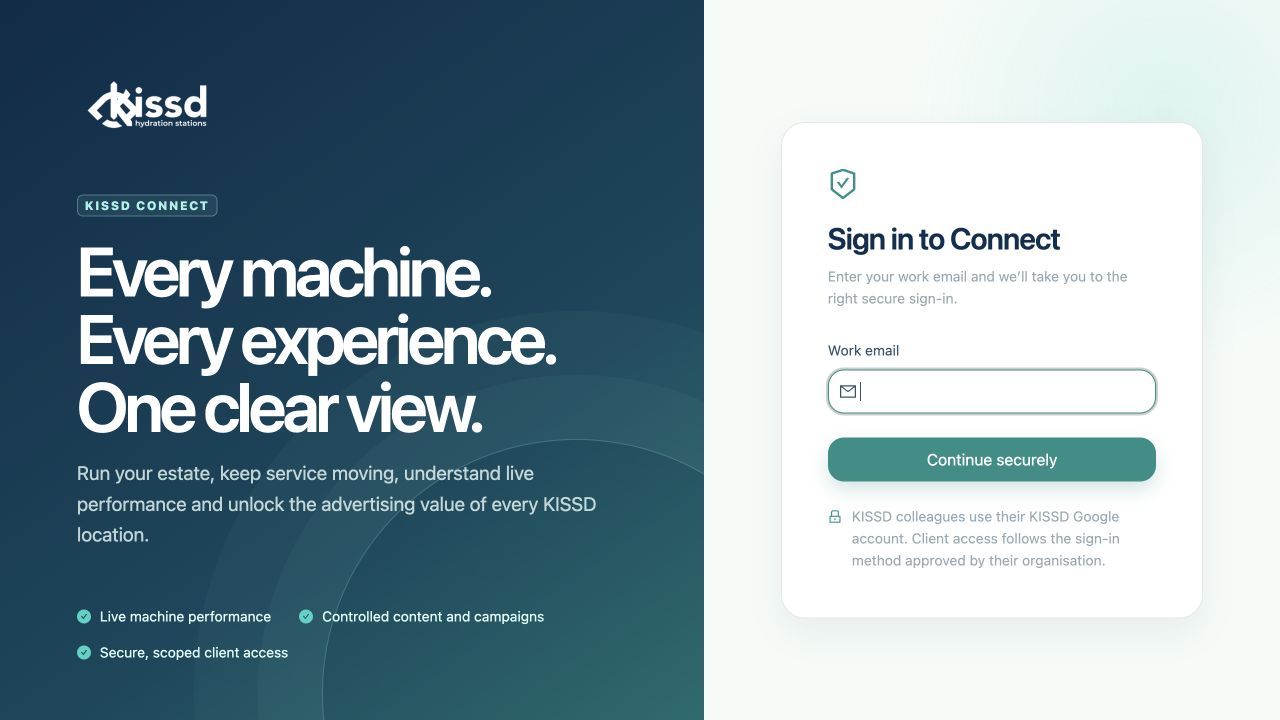
A shared platform with scoped access
Actual Connect staging sign-in, September 2026. Staff and client access enter through organisation-appropriate sign-in.
View full size ↗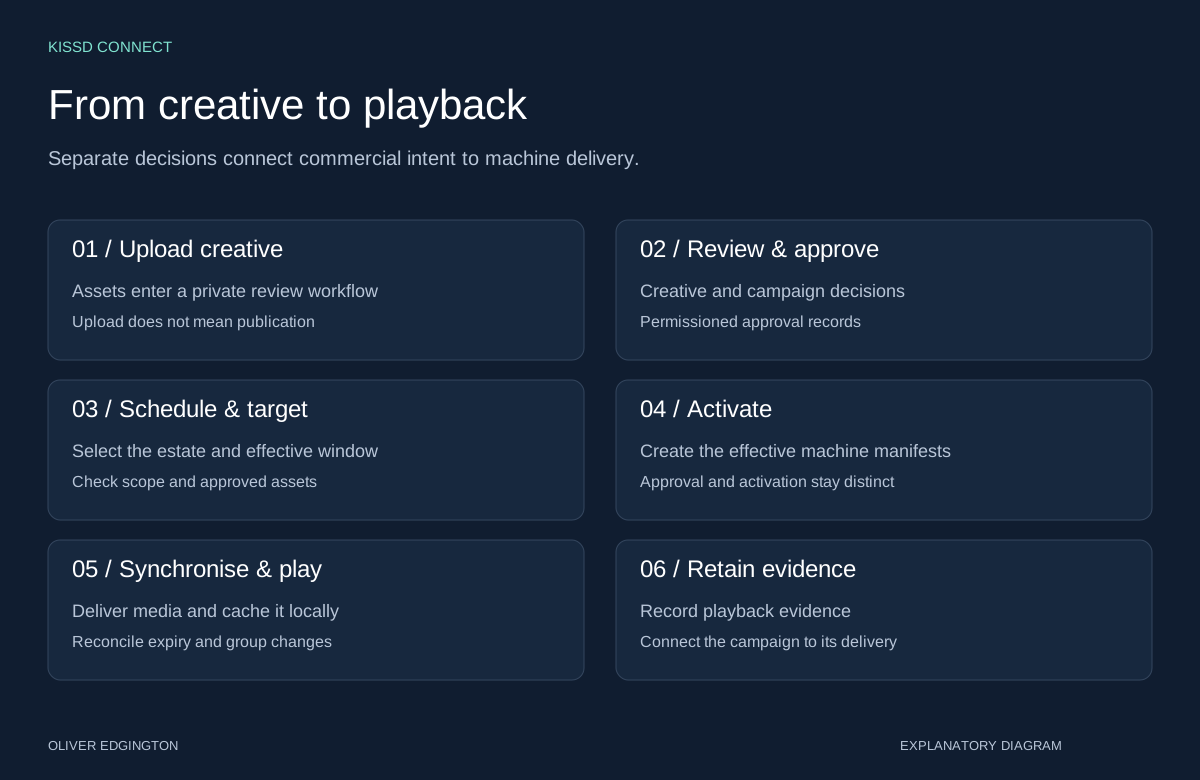
From creative to a machine screen
Explanatory workflow showing separate review and activation steps, targeted delivery and playback evidence.
View full size ↗How the pieces fit
- 01
At the machine
Customer UI, control, local history and cached media
- 02
Synchronisation
Events up; settings, content and releases down
- 03
KISSD Connect
Estate, service, products, people and advertising
03 / Decisions that mattered
The judgement behind the build.
Keep vending local
AWS is not in the critical dispensing path. Local persistence and explicit recovery behaviour let the controller retain its event history through interruptions, then synchronise when connectivity returns.
Own the advertising workflow
Campaign authoring, targeting, assets and playback evidence belong in the same operational context as the machines. The player can use locally cached media, while central tools manage what should be delivered.
Separate identity from permission
Signing in is only the first step. Organisation membership, roles, estate scope and entitlements govern what someone can do. Server-side checks and database isolation preserve that distinction across the platform.
04 / What this enabled
Concrete capabilities. Useful foundations.
- A local controller and simulator covering customer, maintenance, payment and advertising workflows.
- A central operating workspace spanning estate, service, products, advertising and client access.
- A commercial model connecting versioned agreements, entitlements and traceable revenue-share statements.
- Controlled publication paths for product offers, advertising campaigns and machine software.
- A repeatable testing environment for connected-machine behaviour and cloud integration.
The visual shows the development simulator. New Connect capabilities are validated through cloud staging and simulated fleet workflows.
05 / Technical detail
For the closer look.
Machine software persists events locally and synchronises with the cloud. Connect uses domain modules with explicit contracts, server-side authorisation and tenant-scoped PostgreSQL access. Audit and outbox records support traceable changes and retryable external work. The simulation environment is distinguished from physical-machine reporting.
- Node.js
- React
- TypeScript
- Fastify
- SQLite
- PostgreSQL
- AWS
- Raspberry Pi
A similar challenge?
Let’s talk about your business.
If your product combines physical equipment, customer software and a growing operational team, I can help join those pieces into a dependable platform. This is where architecture, product decisions and hands-on engineering need to be considered together.